Tainted Beef Tallow Imported From Vietnam

 See Bahasa Indonesia translation/versi Bahasa Indonesia
 Run across Vietnamese translation
87th Edition : Feb 2021
Key Points
- Australian cattle prices go on to smash all-time price records
- Import numbers driblet sharply in both Indonesia and Vietnam
- This is the kickoff edition translated into Vietnamese
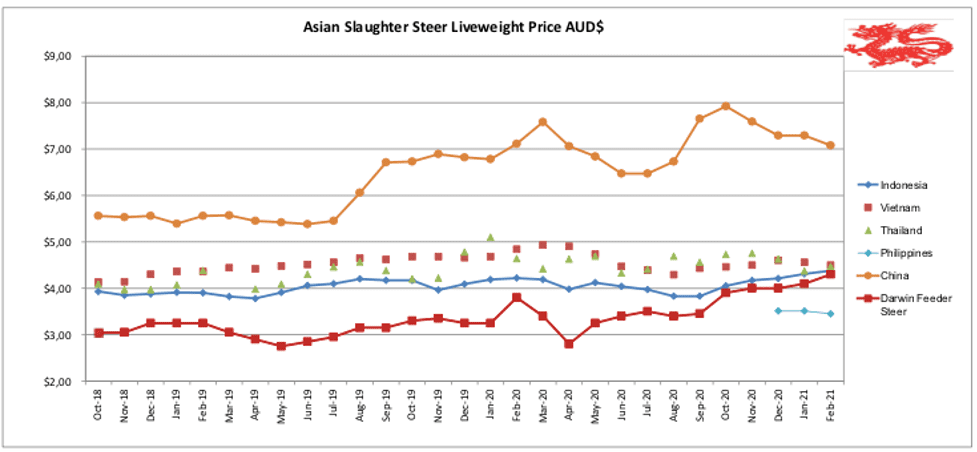
Indonesia: Slaughter Steers AUD $4.38/kg alive weight (Rp10,970 = $1AUD)
Slaughter steer prices continue their steady climb with my indicator charge per unit rising from Rp46,500 per kg live last month to Rp48,000 for February.
This figure was produced from a range of reported rates from as low as Rp46k in Lampung to every bit high as Rp49,000 in Java.
Despite this increment in alive slaughter cattle prices, the rates for fresh beefiness in the wet market remains steady at Rp130,000 per kg.
In contrast, supermarket rates in Djakarta are discounted in two of the major chains with fresh knuckle down from the usual toll of about Rp160,000 per kg to Rp129,000 at the end of February.
Even Australian imported knuckle was discounted to Rp139,000 per kg in the Giant supermarket concatenation.
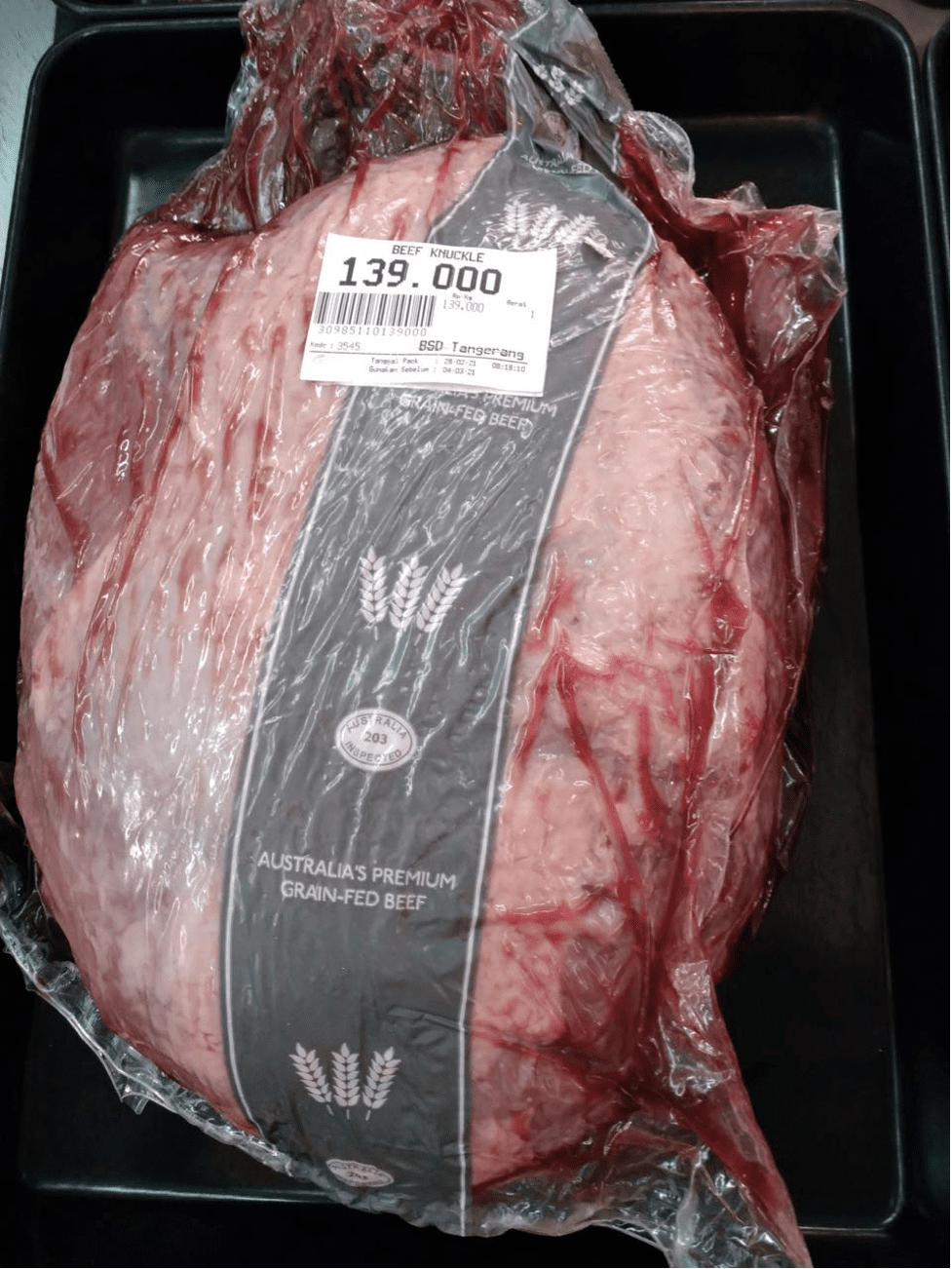
Grain-fed Aussie beef at the very low cost of Rp139,000 per kg or AUD$12.67.
Frozen Indian buffalo meat (IBM) has gone in the opposite direction with a new supermarket rate of Rp95,000 per kg, an increment of more than than xviii% since January.
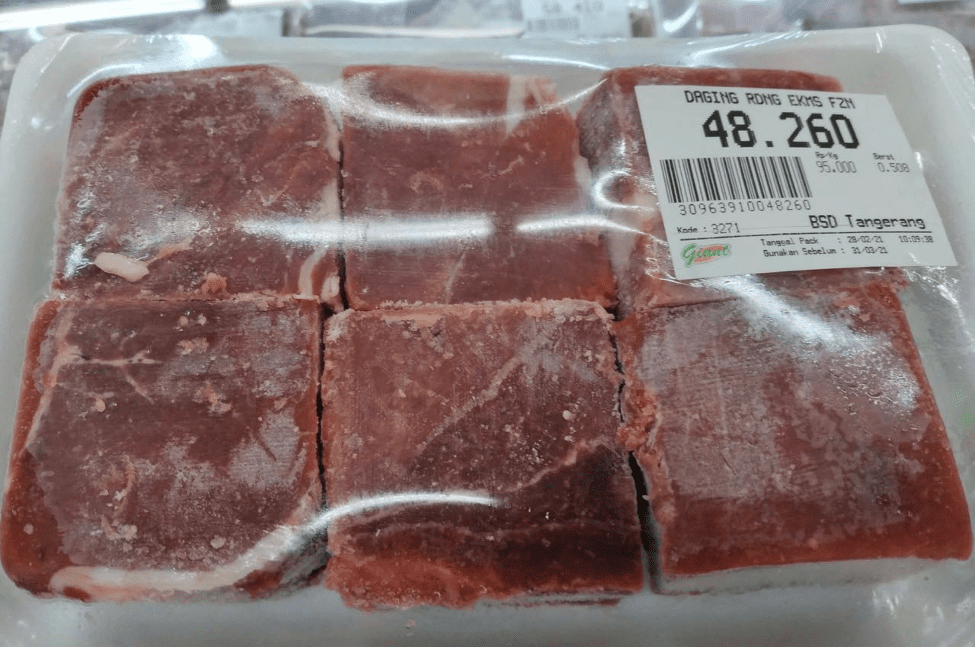
Frozen Indian buffalo beef in the Giant Supermarket, BSD, Tangerang, Jakarta.
Bulog, the State Logistics agency has been given the job to import 80,000 tons of IBM to ensure adequate supplies of beef are available for the festivals of Ramadan, Lebaran and Qurban with the commencement solar day of Ramadan on the 12thursday of April. A spokesman for the agency said that the imports would be conducted in stages in accordance with the market need in order to stabilize the price without harming local farmers. Current stocks of IBM are reported to be 13,600 tons. The aforementioned spokesperson also suggested that the recent beef price hikes were acquired by speculators or cartels. They also doubted that the sole reason for domestic beef price increases were due to the increment of livestock prices in Commonwealth of australia. Concluding year Bulog was given import permits of 100,000 tons but merely imported 37,000 tons of product for the 2020 agenda year.
The contempo proposals for alternative live cattle imports from Mexico don't appear to have make whatsoever significant progress with new reports that Brazil might exist a more than cost-constructive source of alive cattle although their Human foot and Mouth Disease (FMD) disease status (costless with vaccination) is mode below that of Mexico so the risks associated with a Brazilian shipment would be much greater than i sourced from Mexico.
Buffalo imports have increased dramatically during 2020 compared with the previous twelvemonth every bit lot feeders try to reduce the overall cost of their imported stock. The total rose from iii,377 head in 2019 to 6,252 during 2020. 2021 has kicked off with strong numbers again with 777 head exported to Republic of indonesia in Jan and a reported 523 head in Feb.
And then why import alive buffalo when information technology is possible to buy much cheaper frozen Indian buffalo meat? The elementary answer is that fresh buffalo meat from locally slaughtered animals is a totally dissimilar product to frozen Indian buffalo as these animals are culled for advanced historic period from the Indian dairy herd and in most cases lose a great deal of weight between the fourth dimension they are culled and slaughtered. By contrast local or imported buffalo are fed up in order to maximise their slaughter weight and meat quality prior to slaughter in Republic of indonesia. It is also well known that fresh meat has superior eating qualities to frozen product.
Indonesia has commenced vaccinations for Covid 19 with over a meg people having received their first dose of by the end of February.
Darwin feeder steer prices have hit a new all-time high with the current rate sitting at AUD$4.30 per kg alive weight with prices equally high as $4.xl reported for small numbers. These rates will give Indonesian importers no joy with the resulting CIF price at USD$3.90 per kg live landed Jakarta. Import numbers for Jan were virtually 35,000 while February figures are expected to be closer to 20,000 (xv,217 head left the port of Darwin in February for Indonesia). The consensus amidst market specialists is that this price is likely to concord for another month or and then with the offset risk for a fall in rates linked to the ascertainment that a number of areas in the n of Australia have withal not had an acceptable wet season. Prices of slaughter cattle in the Townsville area are hovering around the $3.80 to $4.00 region with the ongoing lack of a satisfactory flavour in large parts of Primal Queensland looming as a potential trigger for a fall in rates.
If these high prices weren't causing enough hurting for exporters, the Australian government has just appear a possible cost ascension for export fees and charges of over 400% over a 3 year period from July 2021. The Australian government operates a price recovery organization for export certification fees and claims that if exports continue equally they are and then the post-obit estimates of fee rises may be the result :
Exporters hope to negotiate a range of administrative efficiencies which volition assist to reduce the level of charges levied by the federal government. The trouble that exporters face is that some of the bureaucrats they are negotiating with will potentially lose their jobs if they cooperate and make the export certification system more than efficient. Good luck with that.
Vietnam: Slaughter Steers AUD $iv.50 / kg (VND18,020 to $1AUD)
Slaughter rates take stabilised this month with no increase over January prices. The indicator cost per kg live weight remains at Dong81,000 although the AUD conversion higher up has inverse slightly due to the appreciation of the Aussie currency during the month. This average is compiled from rates for slaughter steers ranging from 78 to 80,000 Dong per kg alive weight in the south to 81 to 86,000 Dong in the north.
Wet market fresh beefiness prices have also remained the same equally terminal month although in that location has been a significant increment in the price of knuckle in the supermarkets surveyed (Ho Chi Minh City) from Dong 282,000 per kg in January to Dong 314,000 per kg this month. See photo below from VinMart in Ho Chi Minh City. Where possible, all beefiness prices quoted in this study are based on the knuckle (too called the round or quadriceps musculus).
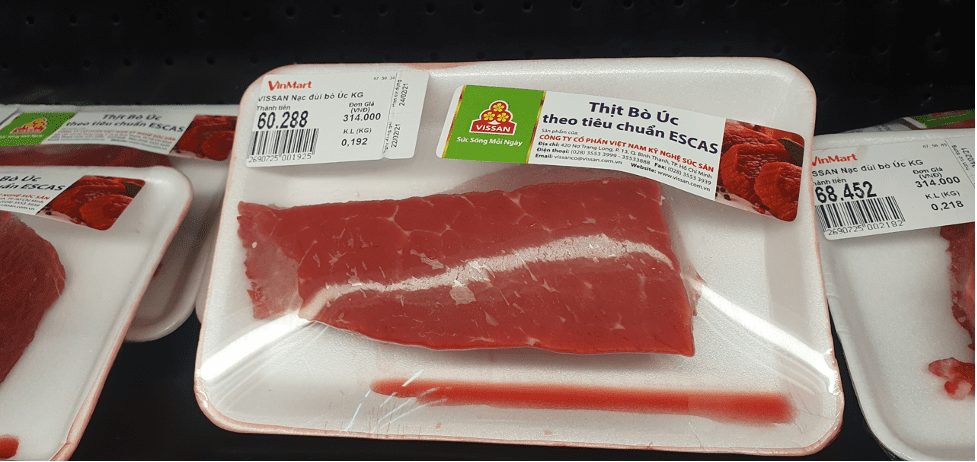
The wording on the label in a higher place confirms that this product is produced by a supply chain which is compliant with ESCAS (Exporter Supply Concatenation Assurance System). ESCAS was established to permit exporters to demonstrate that animal welfare standards were complied with throughout the exporting, importing, handling and slaughter process with total traceability of all individual animals throughout the supply chain backed upward by independent auditors.
Numbers imported during January were effectually 23,000 with shipments for February and the following months predicted to be substantially lower equally Vietnamese need collapses in the face of the consistent toll rises in Australia. The master port which services Vietnam is Townsville in north Queensland where prices have risen rapidly during the latter half of 2020 to effectually AUD$3.80 per kg alive weight for slaughter cattle with recent reports of upwards to $four.00 per kg. Australian livestock are sold in a free market system with no government intervention so prices are determined purely by demand and supply. The fundamental factors driving the Australian cattle market at the moment are generally skillful seasonal conditions post-obit a long drought with farmers retaining females to commence herd rebuilding while domestic restockers are aggressively buying feeder cattle to use vast areas of plentiful pastures.
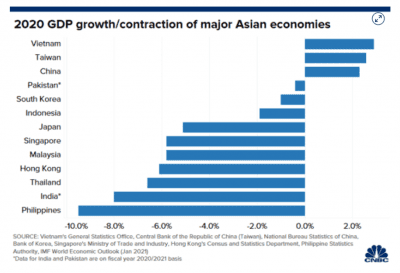
While Vietnamese importers are nether pressure at the nowadays time, the longer term view of the Vietnamese market is very positive with Vietnam delivering one of the best economic performances during the Covid 19 year of 2020. See the table beneath showing Vietnam leading the region with a 2020 GDP growth of 2.9% while the majority of Asian economies produced a negative result. Analysts have predicted Vietnamese Gdp growth for 2021 of between vi and 9% which would almost certainly maintain its position of the fastest growing economic system in Asia. Factors noted for this optimistic view include the extremely effective management of the Covid nineteen pandemic along with a continued migration of manufacturing industries out of China and into Vietnam. The very important tourism industry is also expected to recover afterward in 2021.
Despite this optimistic view of the Vietnamese economic system at that place are withal plenty serious issues facing the domestic nutrient producing industries. The ongoing African Swine Fever (ASF) epidemic has resulted in a large illegal trade selling Vietnamese pigs across the border into China where prices are almost double local rates. This has the potential of seriously reducing supplies in the north of land and driving prices up further.
H5N6 Avian Influenza has been reported in a Quang Minh commune in North Vietnam while the outbreak of Lumpy Skin Disease which commenced in cattle in the Loc Ha commune is still spreading to other districts despite the government's command measures.
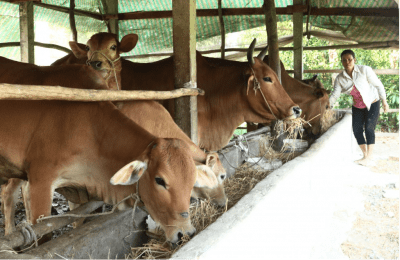
Photo from CanTho Online showing a local farmer raising cattle with support from the government poverty alleviation program in Tra Vinh province in the Mekong Delta.
Buffalo exports from Darwin to Vietnam have connected at a steady rate with iii,825 shipped in 2019 and 3,994 sent during 2020. This places Vietnam as the second biggest importer of alive Australian buffalo with Indonesia the largest receiving 6,252 in 2020. Buffalo are generally caught in the wild and held in yards for extended periods while they are acclimatised to close treatment, dehorned and processed for export. The marketplace toll for buffalo is cheaper than cattle although there are a number of additional costs associated with the shipment of buffalo including additional space requirements on ships that increase their landed costs in the importing country.
The Rum Jungle shambles south of Darwin plans to impale up to 420 buffalo per week or around 16-17,000 during the 2021 flavor. Northern Territory buffalo producers and harvesters are fortunate to take multiple sale options including live export (feeder and slaughter weights), local slaughter and retention of younger females for domestication programs.
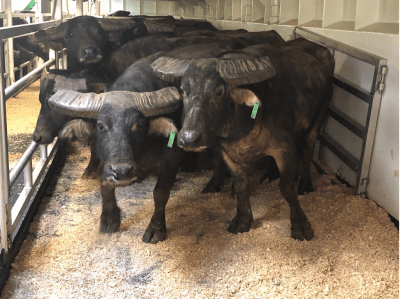
Slaughter buffalo on a live export ship. They must be allocated more space than cattle of the same weight and provided with bedding as in the photo higher up.
This is the offset time that this report has been translated into Vietnamese. The translation has been kindly funded by the Northern Territory Buffalo Manufacture Council, an arrangement which promotes the interests of all those involved in the buffalo manufacture in the Northern Territory which is the only part of Commonwealth of australia that has big wild and domesticated herds of buffalo. These animals were originally imported from Indonesia in the 1860'south to back up one of the early on settlements on the north coast of Commonwealth of australia and were later released into the wild when the settlement failed. Since then these resilient animals take thrived and multiplied in the n coast sub-tropical environs. We hope that a translation into Vietnamese will widen the audience of this written report and provide our customers with a better understanding of the trade. If anyone wishes to brand any comments or suggestions they would exist most welcome.
For more data on the Australian buffalo industry encounter their web site at www.buffaloaustralia.org
China: Slaughter Cattle AUD $vii.08 / kg live weight (RMB v.04 = AUD$)
Slaughter cattle prices in local currency have moved downwards for the first time in many months with rates in Beijing downward to Y36.2 while the price in Shanghai was depressed even further to Y35.2 per kg live weight at the end of February. My communication is that prices are expected to rise once more every bit the demand remains strong with supplies of imported product reduced as a outcome of the pandemic. Pork prices rose again in Beijing but were steady in Shanghai. The Chinese economy appears to be on the rise once more now that the pandemic seems to exist under control and vaccination programs are well under fashion.
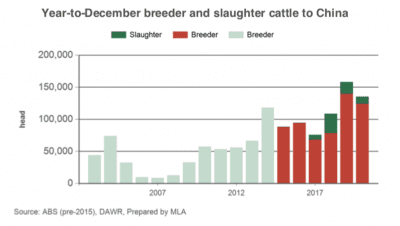
Live exports of beef slaughter cattle continue at insignificant levels with the annual total for 2020 at 10,895 head. During the same twelvemonth 124,000 convenance cattle, mainly dairy cows, were exported live to China.
Philippines: Slaughter Cattle AUD $3.45 / kg (Peso 37.7 to AUD$one)
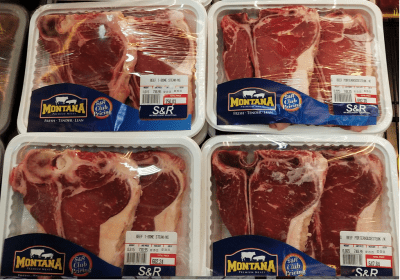
Rates are unchanged from last calendar month at 130 Peso per kg live weight for slaughter steers in Mindanao. The good news is that Covid 19 vaccinations have commenced in the Philippines with the population eager to get their shot and hopefully go back to normality every bit shortly every bit possible. The photos below are from the S&R supermarket in Davao where the reporter noted that the beefiness demand was normal but there appeared to be a shortage of chicken every bit the price has gone up 10% since final month and supermarket shelves are cleared of product less than one hour after stocking.
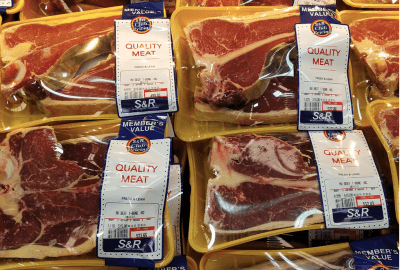
Quality Meat brand T-basic are selling for Peso 515 per kg while the Montana brand T-bones in the photo below are priced at Peso 738 per kg.
Chicken pieces walking out the door at Peso 180 per kg (AUD$4.77)
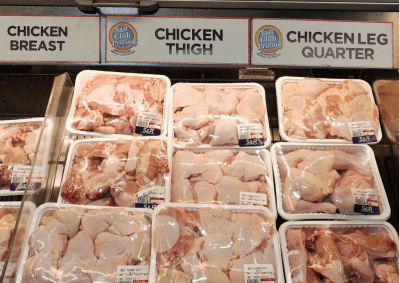
Potongan ayam dijual dengan harga Peso 180 per kg (AUD $ iv,77)
Thailand: Slaughter Steers AUD $4.47 / kg (Baht 23.5 to $1AUD)
I have set the indicator rate at Baht 105 per kg live weight which is up by about iv% from last month. This average is calculated from the February prices of 100THB for fatty cattle 450-500kg and 108-110THB for fat cattle 600kg and over. Feeder cattle are selling for 120 THB per kg alive weight. My amanuensis reports that feed costs are increasing while supplies of Myanmar cattle have virtually stale up and Vietnamese importer need is declining. The general sentiment is of a market place expected to decline in the coming months. The first doses of the Sinovac vaccine have arrived from China concluding week. Everyone volition be offered the vaccine in the usual order of priority, including expatriates and foreign workers.
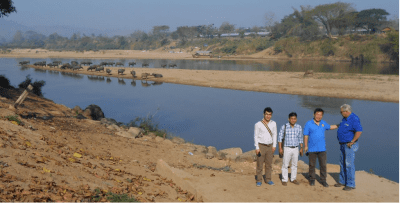
The Moei river is the official border between Myanmar and Thailand in the area of Mae Sot, northward west of Bangkok. On the far bank are the quarantine sheds managed past the Karen ethnic insubordinate group which controls this office of the Myanmar border region. After quarantine checks and a vaccination, cattle and buffalo are walked through the river to the Thai side where they are further quarantined and given a second vaccination for Pes and Mouth Affliction before being allowed "informally" to enter Thailand. This "grayness" route, which has been in functioning for decades, was originally airtight during 2020 equally a result of the pandemic. It'southward non clear if the recent military coup will have any impact on the activities at this blazon of border crossing. This photo was taken in February 2015.
February 2021 prices
These figures are converted to AUD$ from their respective currencies which are irresolute every day then the bodily prices here are corrupted slightly by constant foreign exchange fluctuations. The AUD$ figures presented below should be regarded as reliable trends rather than exact individual prices. Where possible the meat cut used for pricing in the wet and supermarket is Knuckle / Round.
| Location | Engagement | Moisture Market AUD$/kg | Super market $/kg | Broiler craven $/kg | Live Steer Slaughter Wt AUD$/kg |
| Indonesia | Sept 20 | 12.43 | 13.55 B$7.48 | 3.27 | 3.83 |
| Rp10,500 | October twenty | 12.38 | xv.05 B7.62 | 3.xiv | four.05 |
| Rp10,350 | November 20 | 12.56 | xv.27 B7.25 | 3.57 | 4.17 |
| Rp10,700 | December 20 | 12.15 | 14.77 B7.48 | 3.55 | 4.21 |
| Rp10,800 | Jan 21 | 12.04 | 14.63 B7.40 | 3.52 | four.31 |
| Rp10,970 | Feb 21 | xi.85 | 11.fourscore B866 | 3.56 | four.38 |
| Philippines | Sept 20 | 15.43 | 14.86 | 3.49 | v.85 |
| P34.6 | October 20 | 16.18 | xvi.76 | 4.05 | six.50 |
| P35.iii | Nov 20 | 16.43 | 16.71 | 4.67 | vii.22 |
| P36.v | Dec 20 | 15.89 | 16.16 | iv.52 | half-dozen.99 |
| P37.0 | Jan 21 | 13.78 | 14.59 | four.83 | three.51 |
| P37.vii | Feb 21 | thirteen.53 | fourteen.32 | 4.24 | three.45 |
| Thailand | Sept 20 | x.18 | NA | three.10 | iv.56 |
| THB22.ii | Oct 20 | 10.36 | NA | 3.fifteen | 4.73 |
| THB22.1 | November xx | 10.41 | NA | 3.17 | 4.75 |
| THB22.7 | Dec 20 | ten.thirteen | NA | 3.08 | 4.63 |
| THB23.ane | January 21 | 9.96 | NA | three.03 | 4.37 |
| THB23.48 | Feb 21 | 9.lxxx | NA | 2.98 | 4.47 |
| Vietnam | Sept 20 | 18.56 | fifteen.99 | 5.15 | iv.43 |
| D16,600 | Oct 20 | 18.67 | 16.08 | 4.82 | four.46 |
| D16,900 | Nov 20 | 18.34 | 15.79 | NA | iv.50 |
| D17,400 | Dec 20 | 17.82 | 18.97 | 4.42 | 4.lx |
| D17,770 | Jan 21 | 17.45 | 15.87 | four.83 | 4.56 |
| D18,020 | Feb 21 | 17.20 | 17.43 | 4.77 | 4.fifty |
| China Beijing | Sept twenty | 18.78 | 20.00 | iii.71 | 7.55 |
| Y4.8 | October xx | twenty.00 | 21.25 | iii.79 | 7.92 |
| Y4.82 | Nov twenty | 19.92 | 21.99 | 4.06 | 7.47 |
| Y4.94 | Dec 20 | 18.22 | 21.46 | 3.85 | seven.29 |
| Y4.98 | Jan 21 | 18.47 | 22.49 | 3.82 | 7.39 |
| Y5.04 | Feb 21 | 17.46 | 21.43 | 3.69 | 7.18 |
| Shanghai | Sept 20 | 20.82 | 24.08 | 3.57 | 7.76 |
| Pork per kg | Oct 20 | 21.88 | 25.00 | 3.58 | 7.92 |
| Beijing Y66 | November twenty | 21.83 | 24.89 | 4.11 | vii.72 |
| ShanghaiY56 | Dec xx | 19.43 | 23.89 | three.60 | 7.29 |
| Jan 21 | 20.48 | 24.50 | 3.57 | 7.19 | |
| Feb 21 | 19.44 | 24.21 | 3.53 | 6.98 | |
| Darwin Feeder Steer | June 19 $2.xc | July 19 $3.00 | August nineteen $3.15 | Sept 19 $iii.15 | October 19 $3.30 |
| Nov 19 $three.35 | Dec 19 $3.25 | Jan 2020 $three.25 | Feb 2020 $3.eighty | March 2020 $3.40 | |
| Apr 20 $2.eighty | May xx $iii.25 | June 2020 $iii.40 | July 2020 $iii.50 | August 2020 $3.40 | |
| Sept 2020 $3.45 | Oct 2020 $three.90 | Nov 2020 $four.00 | Dec 2020 $iv.00 | Jan 21 $4.x | |
| Feb 21 $4.30 |
Source: https://www.beefcentral.com/live-export/se-asia-report/se-asia-report-mar-2021/
0 Response to "Tainted Beef Tallow Imported From Vietnam"
Post a Comment